1.INTRODUCTION
4U 1820-30 is a low-mass X-ray binary (LMXB) located near the center of the globular cluster NGC 6624. The binary orbital period is P1 ≃ 685 s, revealed in X-ray observations as a modulation with ∼2%–3% peak-to-peak amplitude (Stella etal. 1987). Subsequently, Anderson etal. (1997) discovered a ∼16% peak-to-peak modulation (period 687.6 ± 2.4s) in the UV band from the Hubble Space Telescope (HST).
This short-period, low-amplitude variation is very stable, with  (Chou & Grindlay 2001), which is consistent with the earlier measurement of
  from van der Klis etal. (1993b); this stability led Chou & Grindlay (2001) to suggest that this modulation reflects the orbital period of the binary.
Both the short binary period and the type I X-ray bursts observed in this system imply that the secondary star is a helium white dwarf, of mass m2 = (0.05–0.08) M☉, accreting mass onto a primary neutron star (Rappaport etal. 1987). The distance to the source is estimated to be 7.6 ± 0.4 kpc (Kuulkers etal. 2003).
It is striking that neither the magnitude nor the sign of the period derivative is consistent with the prediction  of the standard evolution scenario for compact binaries overflowing their Roche lobe (Rappaport etal. 1987). It has been suggested that the negative period derivative is only apparent, i.e., that it is not intrinsic to the binary, but instead reflects the acceleration of the binary in the gravitational potential of the globular cluster which houses the binary (van der Klis etal. 1993a). However, quantitative estimates show that the acceleration, while of roughly the right magnitude, is unlikely to be large enough, by itself, to explain the large discrepancy between the evolution scenario and the observations (van der Klis etal. 1993a; King etal. 1993; Chou & Grindlay 2001).
A second striking property of 4U 1820-30 is the much larger luminosity variation, by a factor of ≳ 2, seen at a period of P3 ≃ 171days (Priedhorsky & Terrell 1984; Chou & Grindlay 2001; Zdziarski etal. 2007). Analysis of the RXTE All Sky Monitor data shows that this long-period modulation does not exhibit a significant period derivative,  (Chou & Grindlay 2001). The ratio between this long period and the binary orbital period is ≃ 2 × 10⁴, which appears to be too high to be due to disk precession at the mass ratio of the system (Larwood 1998; Wijers & Pringle 1999).
In this paper we adopt the assumption of Grindlay (1988) that the 171day period is due to the presence of a third body in the system. The third (outer) star modulates the eccentricity of the binary at long-term period P3 ≃ P22/(eP1), where P2 is the orbital period of the third star and e is the eccentricity of the inner binary. Taking into account only perturbations from the third star, the binary orbital period of 685 s and ∼171day long-term modulation imply that the orbital period of the third star must be ∼1day. The presence of additional sources of precession, such as that due to tidal distortion of the white dwarf secondary, requires a stronger perturbation from the third body and hence a smaller orbit in order to modulate eccentricity of the inner binary at the 171day period. We show that the luminosity modulation arises from variations in the eccentricity of the inner binary associated with libration around a stable fixed point in the Kozai resonance.
Tidal dissipation in the white dwarf, driven by the eccentricity of the binary orbit, tends to decrease both the eccentricity and the semimajor axis (hence period) of the binary, which we suggest is responsible, in part, for the anomalous observed period derivative—note that Rappaport etal. (1987) did not treat the effects of tidal dissipation. The combination of tidal dissipation and mass transfer will result in a lower value of  than that produced by conservative mass transfer alone.
For rapid enough dissipation or, expressed another way, for low enough values of the tidal dissipation parameter Q,  could result. We do not favor this as the explanation for the observed negative period derivative; we show that such rapid dissipation damps eccentricity within 10−3 of the system's lifetime. Subsequently, the mass transfer takes over the evolution of the semimajor axis. In other words, we would be incredibly lucky to observe the system in the short time that e is significant, in the absence of another perturbing influence. We also show that, given the most recent estimates for the acceleration of millisecond pulsars in the gravitational field of the globular cluster, the cluster gravity does not appear to contribute significantly to the observed period derivative of 1820-30.
Thus, it appears that, while both tidal dissipation and acceleration in the gravitational field of the cluster contribute negatively to the period derivative, they cannot fully explain it. Since we favor the hierarchical triple model as an explanation for the origin of 171day period of luminosity variations, we suggest that the apparent negative period derivative, which is a 2σ result, may either be an observational artifact or due to the some yet not understood physical processes.
The relation between the luminosity variations and the period derivative is deeper; we argue that the (intrinsic) increase in the semimajor axis of the binary (driven by Roche lobe overflow) leads to trapping of the system deep in the Kozai resonance. The resonance transfers angular momentum from the inner binary to the third star, and back, periodically, without affecting the semimajor axis of either orbit. However, the dissipation associated with the strong tides when the forced eccentricity is largest does remove energy from the orbit of the inner binary. This energy loss peaks when the mutual inclination is small. It is well known that this coupled Kozai-tidal evolution tends to leave the system with a mutual inclination between the two orbits near the Kozai critical value (∼40°); see, for example, Figure4 in Wu etal. (2007) or Figure7 in Fabrycky & Tremaine (2007). We show that the period of small oscillations is naturally ∼170days when the mutual inclination is close to the Kozai critical value. Whether the evolution of the inclination in systems like 1820-30, unlike the planetary systems, is known to undergo Roche lobe overflow is a question we are currently investigating.
This paper is organized as follows. In Section2 we develop an analytic understanding of the system, describing the resonance dynamics, calculating the location of the fixed point as a function of the system parameters (stellar masses, orbital radii, and the mutual inclination of the two orbits), and the frequency (or period) of small oscillations. In Section3 we describe a possible dynamical path by which the system arrived at its present configuration. The dynamical history relies crucially on both the Roche lobe overflow (which drives the system into resonance) and the tidal dissipation, which tends to drive the mutual inclination toward the Kozai critical value. In Section4 we describe the results of numerical integrations of the equations of motion, presenting a fiducial model that reproduces the observed properties of 4U 1820-30. We also demonstrate trapping in the case of an expanding inner binary orbit, and detrapping in the case of a shrinking binary orbit. In Section5 we use the model to put constraints on the ratio of the tidal dissipation parameter Q and the tidal Love number (k2) of the helium white dwarf for our fiducial eccentricity. We discuss our results, and those of previous workers, in Section6. We present our conclusion in the final section. We give the details of the numerical model in AppendixA. In AppendixB, we discuss in detail the adiabatic invariance of the action and how it governs the evolution of the system by comparing analytic and numerical analysis.
2.UNDERSTANDING THE DYNAMICS OF THE 4U 1820-30 SYSTEM
The presence of a third body orbiting the center of mass of a tight binary will induce changes in the orbital elements of the binary, changes that take place over a variety of timescales. The changes are particularly dramatic if the mutual inclination of the two orbits is large. Kozai (1962) showed that when the initial inclination between inner and outer orbits has values between some critical inclination ıcrit and 180° − ıcrit, both the eccentricity of the inner binary and the mutual inclination undergo periodic oscillations known as Kozai cycles.
The period of the Kozai cycles is much longer than either the binary's orbital period or the period of the outer orbit. This justifies the use of the secular approximation, which involves averaging the equations of motion over the orbital periods of the inner and outer binaries; as a result, the averaged equations of motion predict that the semimajor axes of both binaries are unchanged.
If the luminosity variations in 4U 1820-30 are due to Kozai cycles, the semimajor-axis ratio aout/a ≈ 8, so in our analytic work we use the quadrupole approximation for the potential experienced by the inner binary due to the third body. In our numerical work we keep terms to octupole order, but we show that the higher order terms change the quantitative results only slightly.
The angular momentum of the outer binary is much greater than that of the inner, so that the orientation of the outer binary is, to a good approximation, also a constant of the motion. In that case, after the averaging procedure, the final Hamiltonian has one degree of freedom.
Kozai cycles are the consequence of a 1: 1 resonance between the precession rates of the longitude of the ascending node Ω and the longitude of the periastron ϖ of the inner binary. The condition for Kozai resonance,  , is satisfied only for high-inclination orbits; for low inclinations, the line of nodes precesses in a retrograde sense (
 ), while the apsidal line precesses in a prograde sense.
We employ Delaunay variables to describe the motion of the inner binary. The angular variables are the mean anomaly l, the argument of periastron ω, and the longitude of the ascending node Ω; of these, only ω appears in the averaged Hamiltonian. Their respective conjugate momenta are



The longitude of periastron is ϖ ≡ Ω + ω. Recall that we are assuming that the semimajor axis of the outer binary is large enough that the total angular momentum is dominated by that of the outer binary, so that ı is effectively the mutual inclination between the two binary orbits. We occasionally refer to the elements of the third star, using a subscript "out" to distinguish them from those of the inner binary.
After averaging over l and lout, the Hamiltonian describing the motion of a tight binary orbited by a third body, allowing for the effects of both tidal and rotational bulges on the secondary, and for the apsidal precession induced by general relativistic effects, is (Innanen etal. 1997; Ford etal. 2000; Fabrycky & Tremaine 2007)
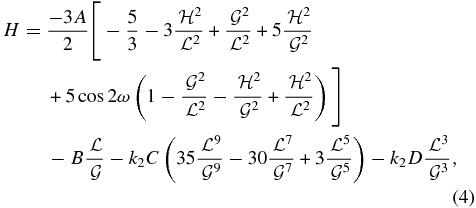
where the term proportional to A is the Kozai term, the term proportional to B enforces the average apsidal precession due to general relativity (GR), and the terms proportional to C and D represent the tidal and rotational bulges, respectively; the explicit appearance of the tidal Love number k2 in the latter two terms highlights the fact that these terms represent the effects of the white dwarf's tidal and rotational bulges. The expressions for the constants are




where

Recall that the semimajor axis and eccentricity of the outer body's orbit are denoted by aout and eout. The quantity rs ≡ 2Gm1/c2 in Equation(6) is the Schwarzschild radius of the neutron star.
As just noted, the term proportional to D accounts for the rotational bulge produced by the spin of the white dwarf. The spin is projected onto the triad defined by the Laplace–Runge–Lenz vector, pointing along the apsidal line from the white dwarf at apoapse toward the neutron star, and denoted by a subscript e; the total angular momentum vector, denoted by a subscript h; and their cross product, denoted by q. We have scaled the spin to the orbital frequency (or mean motion) n, so that, e.g.,  . We do so because we anticipate that for small eccentricity the white dwarf will be tidally locked. Then
  is a dimensionless quantity of order unity.
For the fiducial values of the system parameters listed in Table1, A ≈ 1.73 × 1044, the ratios B/A ≈ 0.53, C/A ≈ 1.82, and D/A ≈ 2.54.
Table 1.System Parameters
| Symbol | Definition | Value | Reference |
|---|---|---|---|
| m1 | Neutron star (primary) mass | 1.4 M☉ | |
| m2 | White dwarf (secondary) mass | 0.067 M☉ | Rappaport etal. (1987) |
| m3 | Third companion mass | 0.55 M☉ | |
| a1 | Inner binary semimajor axis | 1.32 × 1010 cm | Stella etal. (1987) |
| aout | Outer binary semimajor axis | 8.0a1 | |
| ein, 0 | Inner binary initial eccentricity | 0.009 | |
| eout, 0 | Outer binary eccentricity | 10−4 | |
| iinit | Initial mutual inclination | 44 715 715 | |
| ωin, 0 | Initial argument of periastron | 90° | |
| Ωin | Longitude of ascending node | 0 | |
| R2 | White dwarf radius | 2.2 × 109 cm | |
| k2 | Tidal Love number | 0.01 | P. Arras (private communication) |
| Q | Tidal dissipation factor | 5 × 10⁷ |
Download table as: ASCIITypeset image
2.1.The Kozai Mechanism
We start our discussion of the dynamics of the system by focusing on understanding the Kozai mechanism, neglecting forces due to the tidal and rotational bulges of the helium white dwarf in the inner binary, and the effects of GR.
We locate the resonance by looking for a fixed point of the Hamiltonian; since we are neglecting the tidal and rotational bulges, and the general relativistic precession, we set B = C = D = 0 and differentiate the Hamiltonian with respect to ω, to find ωf = 0°, 90°, 180°, 270°. The fixed points at ωf = 90° and ωf = 270° are stable. Differentiating the Hamiltonian with respect to  , substituting ω = 90° (or 270°) and setting the result equal to zero, we find
  . In terms of the eccentricity,

where the subscript f indicates that this is the eccentricity of the stable fixed point. The frequency of small oscillations around the fixed point (small librations) is

Performing the derivatives,

where we have defined

The last factor in Equation(12) is efsin ıf.
In terms of the eccentricity,

From Equation(10) we see that the critical inclination for a Kozai resonance to occur, in the absence of other dynamical effects, is  . If ı > ıcrit, orbits started at ω = 90° with e < ef will librate around the fixed point, so that ω remains between 0° and 180° (or an even more restricted range). From Equation(12) or Equation(14), the period of small oscillations P0 ∼ 1/ef, a point that will be important later.
In contrast, orbits started at ω = 0° and e > 0 will circulate (ω will range from 0° to 360°). Librating and circulating orbits are separated by the separatrix, an orbit that neither librates nor circulates. The width of the separatrix (as measured by the excursion in e) depends only on the initial inclination: esep = [1 − (5/3)cos 2ı]1/2.
Examples of librating and circulating orbits (for a system including the effects of GR and tidal bulges) are shown in Section4.
Note that even for systems with ı < ıcrit, where no stable Kozai fixed point exists, both the mutual inclination and the eccentricity of the inner binary can undergo oscillations with significant amplitude (although reduced compared to the case with ı > ıcrit).
Kozai cycles will be substantial only as long as the perturbation from the outer body dominates over the other sources of apsidal precession in the inner binary orbit, a point we now address.
2.2.Kozai Cycles in the Presence of Additional Forces
The physical effects represented by the terms proportional to B, C, and D are capable of suppressing Kozai oscillations. We investigate their effects in this section.
As an aside, there is a small apsidal precession introduced by dissipative effects in the He white dwarf, but this precession rate is negligible compared to the other three. We mention it here because tidal dissipation has a major role to play in the capture (or otherwise) of the system into the Kozai resonance.
The equations for the precession rates due to the Kozai mechanism, general relativity, and the tidal and rotational bulges of the white dwarf are
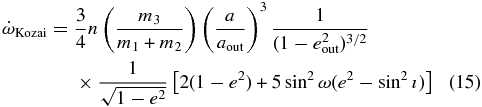



The Kozai term (Equation(15)) can be either positive or negative, depending on the value of sin ı. Both the white dwarf tidal bulge and the GR terms are positive, so both tend to suppress Kozai oscillations. The term induced by the white dwarf rotational bulge, on the other hand, can be of either sign, depending on the orientation of the white dwarf spin. If the white dwarf is tidally locked and if its spin is aligned (which we assume in our analytic model, but not in our numerical models), this term contributes positive  . In case of non-aligned spins the precession rate may be negative (as we will see).
2.2.1.The Tidal Bulge and the Tidal Love Number k2
The tidal bulge of the white dwarf in 4U 1820-30 dominates the non-Kozai apsidal precession rate, for physically plausible values of k2. We remind the reader that in Newtonian gravitational theory the tidal Love number k2 is a dimensionless constant that relates the mass multipole moment created by tidal forces on a spherical celestial body to the gravitational tidal field in which it is immersed; in other words, k2 encodes information about body's internal structure.2
We use k2 = 0.01, which is computed by P. Arras (2011, private communication) as the ratio of the potential due to the perturbed mass distribution, to the external potential causing the perturbed mass, under the assumption that our He white dwarf is a fluid object.
Soft X-ray observations of the source indicate a rather small absorption, consistent with that expected to be produced by the interstellar medium of the Galaxy; this rules out any significant outflows from the accretion disk or the surface of the white dwarf. This implies an absence of mass loss through the L2 Lagrangian point of the white dwarf, which puts an upper limit on the eccentricity of the inner binary; according to Regös etal. (2005), for our system parameters, the upper limit on the eccentricity of inner binary is emax ≃ 0.07.
If 4U 1820-30 has a non-zero but small eccentricity, as indicated by the observed luminosity variations, then in the absence of a third body, the precession rate of the binary orbit is dominated by the tidal bulge induced in the white dwarf by the gravity of the neutron star; from Equations(16) and(17), the tidal bulge induces a precession rate at least a few times that induced by GR:

In order for the Kozai mechanism to produce significant variations in e, the Kozai-induced precession rate must be comparable to or larger than the sum of the precession rates produced by the other terms. For physically realistic values of k2, as we have just seen, the precession rate induced by the tidal bulge of the white dwarf is by far the largest, so if the Kozai effect is to be important, it must produce a precession rate larger than  .
.
2.3.Libration Around the Fixed Point and the Frequency of Small Oscillations
2.3.1.Why Libration?
For the values of the tidal Love number k2 and eccentricity listed in Table1, the period of the precession rate induced by the tidal bulge,  , is a factor of 10 shorter than the period of the observed luminosity variations. If this term set the rate of precession, and the eccentricity varied as a result of this precession, then the variations in X-ray luminosity would occur with a period substantially shorter than the observed 170days.
In order to produce a much longer period, some other terms must tend to produce a negative precession rate. When this negative precession rate is added to that produced by the tidal bulge, the resulting period can be much longer than that produced by the tidal bulge alone.
Under the assumption that the white dwarf is tidally locked (we show later that it is not), the only term capable of producing a negative precession rate is the Kozai term. Hence, we are led to look for a cancellation between the Kozai precession rate and the precession rate induced by the tidal bulge.
However, it is not enough to ask for a rough cancellation. To get the observed precession rate, the sum of all the terms must cancel to better than 10%. This requires some fine tuning of the mutual inclination, a rather unsatisfactory situation.
On the other hand, if the system is captured into libration, then the sum of all the precession terms is exactly zero. If the system is deep in the resonance, then the period of libration is simply the period associated with small oscillations around the fixed point. We show here that the period of small oscillations is naturally around 170days, if the mutual inclination is near the critical value for Kozai oscillations.
2.3.2.The Frequency of Small Oscillations
Setting the first derivative of the Hamiltonian(4) with respect to ω and  to zero, we find the following expression for the location of the stable fixed points in the limit of small eccentricity:


We can write the second of these as

where

Evaluating the second derivative of the Hamiltonian at the fixed point, we obtain the expression for the frequency of small oscillation around the fixed point:
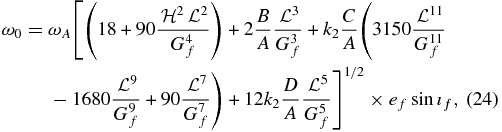
which should be compared to Equation(12). As in the pure Kozai case, the period of small oscillations P0 ∼ 1/ef.
Figure1 shows P0 as a function of the initial inclination. As the initial inclination increases above the critical value, the period of small oscillations decreases rapidly. Increasing the initial inclination increases the magnitude of the Kozai torque; in the absence of other torques, and for inclinations above the critical inclination, increasing the magnitude of the Kozai torque is analogous to increasing the restoring force in a harmonic oscillator, thereby increasing the frequency of oscillation. When there are other torques in the problem, the critical inclination will change; for example, the presence of a tidal bulge on the secondary increases the critical inclination.
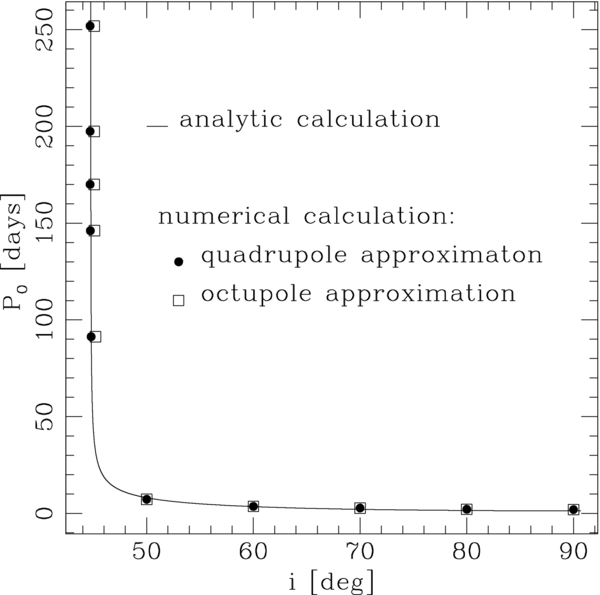
Very near the critical inclination, the effective restoring force is small, ∼efsin ıf, so the frequency of small oscillations is small, and the period of oscillations is large—hence the rapid increase in P0 as the inclination decreases toward the critical inclination (ıcrit ≈ 44° in Figure1).
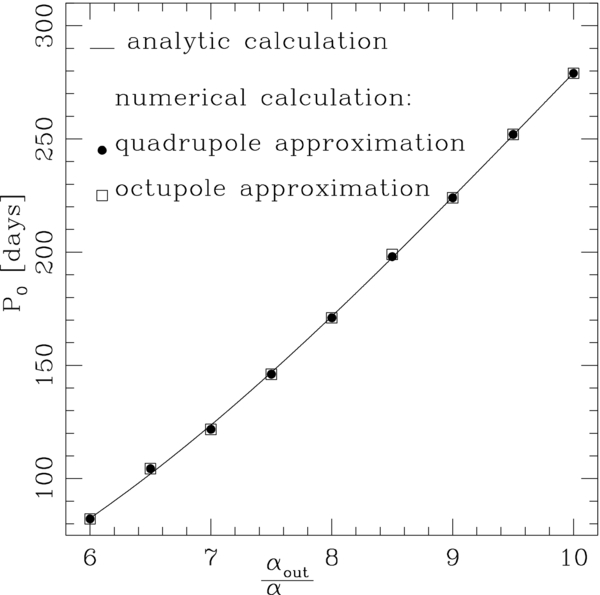
Figure2 shows P0 as a function of aout. As expected from the nout ∼ a3out dependence of ωA, the period of eccentricity oscillations increases rather rapidly with aout.
3.MASS TRANSFER, TIDAL DISSIPATION, AND CAPTURE INTO LIBRATION
We have shown that physically plausible values of k2 lead to a precession frequency  that is much larger than the observed frequency of luminosity variations in 4U 1820-30. We then appealed to an equally large precession, of the opposite sign, produced by the Kozai interaction, to cancel the prograde precession caused by the tidal bulge. In order to avoid fine tuning, we argued that the system has to be in libration, so that the observed low frequency actually arises from libration, rather than precession of the apsidal line of the binary orbit.
Whether the tidal bulge or GR effects produce a larger precession rate, we argue that it is no coincidence that the magnitude of the Kozai precession rate is equal to the sum of the other precession rates: the system will evolve so as to capture the orbit into resonance, in which the sum of all the precession rates is zero.
Capture into libration in the Kozai resonance is a natural consequence of semimajor-axis expansion, the latter driven by mass loss from the white dwarf as a result of its overflowing its Roche lobe. The action  is an adiabatic invariant (for detailed discussion see AppendixB), since the semimajor axis of the binary orbit is expanding on the accretion timescale
  , much greater than either the orbital or precession timescale. In contrast to mass transfer, tidal dissipation tends to shrink the semimajor axis; if this effect dominates, trapping into the Kozai resonance is not possible.
How does expansion of the inner orbit lead to capture into libration? As a increases, the mutual torque between the two orbits will increase as well—the inner orbit is expanding, effectively moving closer to the outer orbit. This increasing torque corresponds to a deepening of the Kozai potential, and an expansion in the size of the separatrix of the Kozai resonance. Orbits other than the separatrix have a fixed action, while the action of the separatrix is increasing. If the increase in the action of the separatrix grows to exceed the action of an initially circulating orbit, that circulating orbit will be captured into resonance and begin to librate. As a continues to expand, the captured orbit will move closer and closer to the fixed point of the resonance, librating with the frequency of small oscillations.
More quantitatively, mass transfer tends to increase a (Rappaport etal. 1982):

where q = m1/m2 and  ; k is the Boltzmann constant, μ is the mean molecular weight, mp is the mass of the proton, and
  is the polytropic temperature. The parameter K is given by the following mass–radius relation:

where Nn is a tabulated numerical coefficient (for n = 1.5 it is 0.4242; Chandrasekhar 1939).
Tidal dissipation in the white dwarf will tend to reduce the semimajor axis of the binary. In the limit of small eccentricity,

We argue that the orbit must be expanding.  is 100 times shorter than
  , so unless something excites e (such as third body or thermal tides) we are unlikely to catch the system in a phase where periastron, rp = a(1 − e), is increasing while a is decreasing.
4.NUMERICAL RESULTS
4.1.Numerical Model Using the Quadrupole Approximation
Our numerical model treats the gravitational effects of the third body in the quadrupole approximation. We average over the orbital periods of both the inner binary and the outer companion. We demonstrate in Section4.4 and in Figures1 and2 that treating the effects of the third body in octupole approximation does not qualitatively change our findings. We include the following dynamical effects.
1.
Periastron advance due to GR.
2.
Periastron advance arising from quadrupole distortions of the helium white dwarf due to both tides and rotation.
3.
Orbital decay due to tidal dissipation in the white dwarf.
4.
Loss of binary orbital angular momentum due to gravitational radiation.
5.
Conservative mass transfer from the helium white dwarf to the neutron star primary driven by the emission of gravitational radiation.
Note that the Kozai mechanism described in the previous section is included in the three-body gravitational dynamics. The equations used in our model are listed Appendix A.
4.2.Results
We use as fiducial parameters m1 = 1.4 M☉, m2 = 0.067 M☉, and m3 = 0.55 M☉. The semimajor axis of the inner binary is a = 1.32 × 1010 cm, chosen to match the observed orbital period of 685 s. The radius of the helium white dwarf is R2 = 2.2 × 109 cm, while the fiducial Love number is k2 = 0.01.
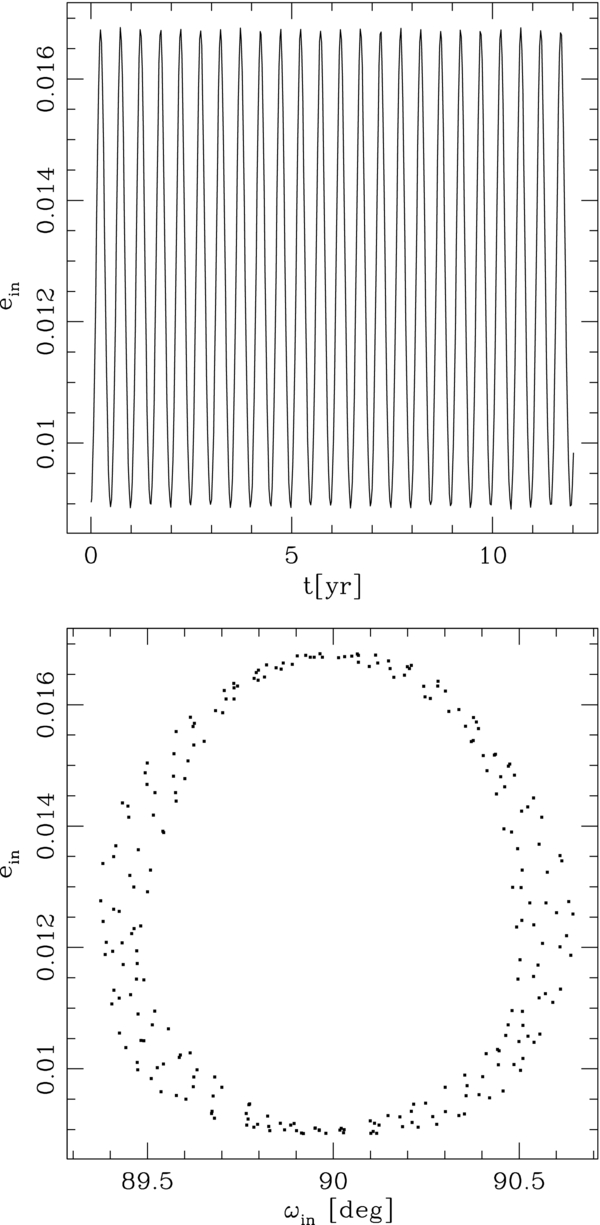
To reproduce the 171day eccentricity oscillations (Figure3), we use the following initial parameters: aout = 8.0a (yielding Pout = 0.15days). We start with e0 = 0.009, ω0 = 90°, ıinit = 44715, and eout, 0 = 10−4.
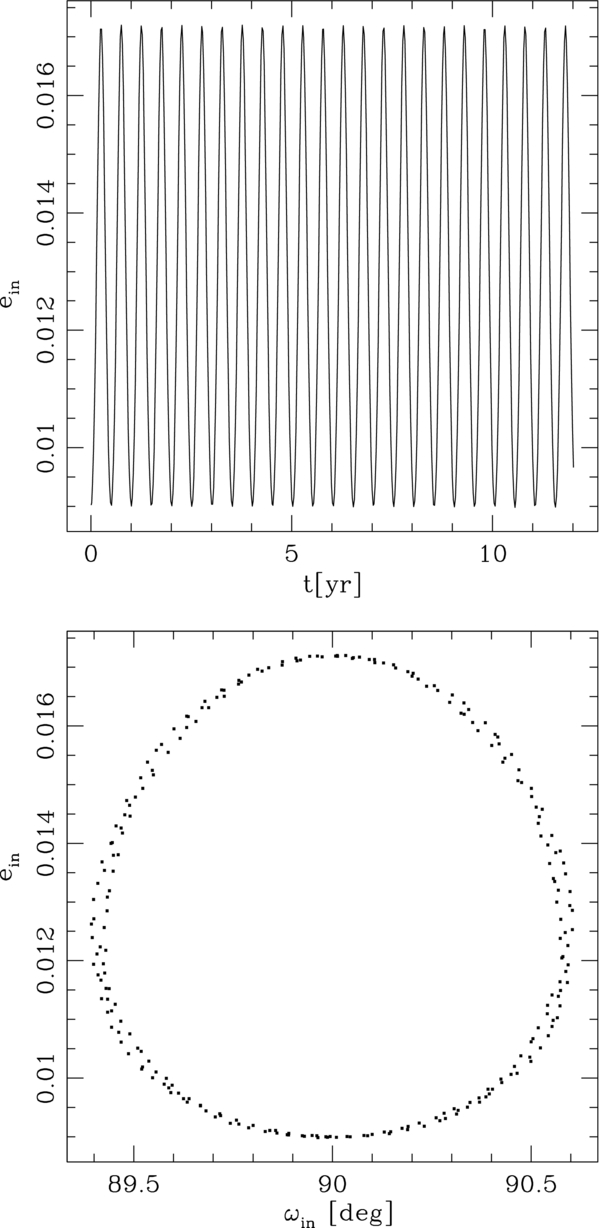
Figure3 shows the eccentricity oscillations of the inner binary, with a period of 171days, over a decade. The amplitude of the eccentricity oscillations is of order of 7 × 10⁻³, which is sufficient to enhance mass transfer enough to produce the observed luminosity oscillations of a factor of ≳ 2 (Zdziarski etal. 2007; see their Figure 3). The amplitude of the eccentricity oscillations depends on the initial eccentricity, as illustrated in Figure4; a lower initial eccentricity produces eccentricity oscillations with higher amplitude. If the system circulates, the amplitude of the eccentricity oscillations is larger still.
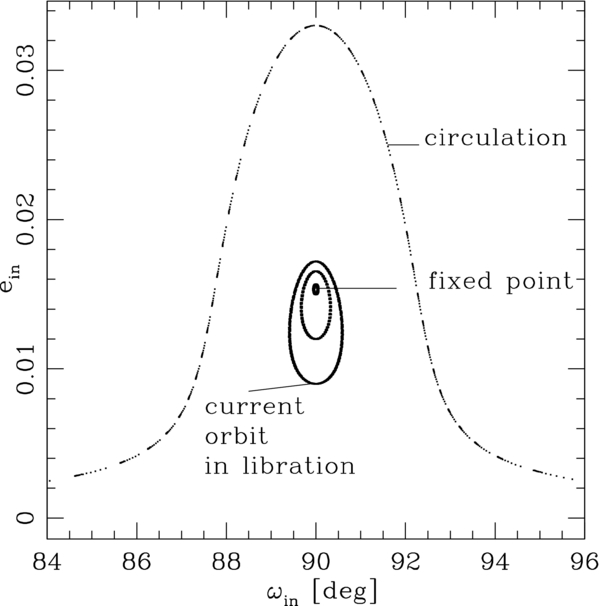
Having the system trapped in libration about the fixed point explains both the origin of the 171day period luminosity variations, as well as the small amplitude of the eccentricity oscillations; the observations require that magnitude of the eccentricity oscillations be small so as to avoid overly large luminosity variations—a point we return to below.
4.3.Resonant Trapping and Detrapping of 4U 1820-30
The mass transfer rate is determined by the inner binary mass and semimajor axis. These parameters are reasonably well constrained from observations (Stella etal. 1987; Anderson etal. 1997; Rappaport etal. 1987). The amount of tidal dissipation is parameterized by the tidal dissipation factor Q, which for white dwarfs is not well constrained at all. If we know the value of the period derivative,  , we can constrain Q (or more precisely, (e/0.009)2Q/k2; see Equation(27)) for the white dwarf in the system.
We argued at the end of Section3 that the intrinsic  must be positive, since a shrinking binary orbit and a decaying eccentricity quickly lead to mass transfer driving expansion of the binary orbit. There is a second argument against an intrinsic negative
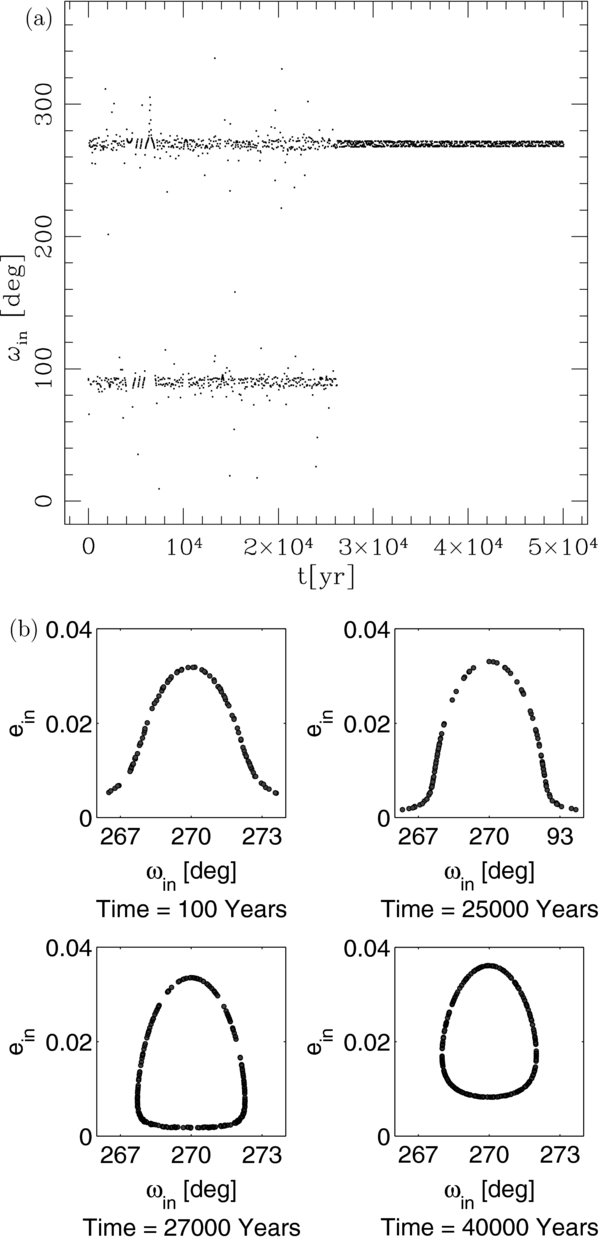
  : if the orbit of the inner binary is shrinking, an initially librating orbit will quickly become circulating, and the period of luminosity variations will change dramatically. If we tune Q to the value that reproduces the observed negative period derivative (Q = 2.5 × 10⁷, assuming k2 = 0.01) and let the system evolve, the system is driven out of libration after about 1500 yr, as shown in Figure5. As the figure shows, the eccentricity of the inner binary decreases significantly due to tidal dissipation, which in turn reduces the strength of tidal dissipation. With tidal dissipation weakened, mass transfer will dominate the evolution of the semimajor axis and, as expected from the standard evolutionary scenario, the semimajor axis starts to expand (not shown in the figure). As long as there is some small eccentricity in the inner binary there is some tidal dissipation present that tends to slow down the expansion rate of the semimajor axis.
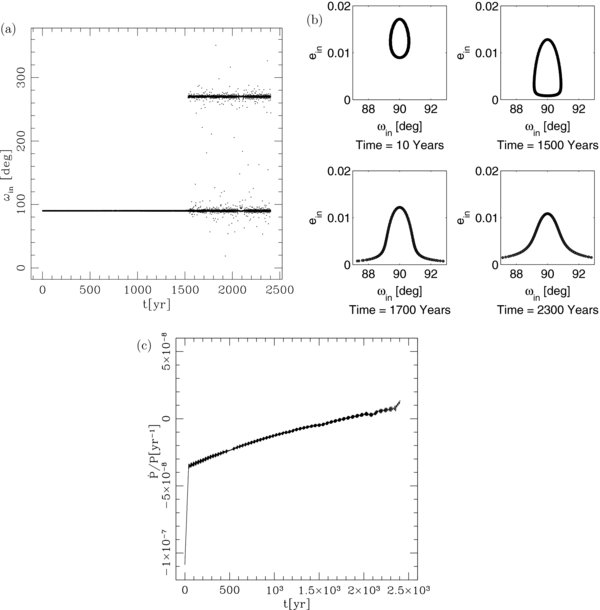
The reason for the detrapping is rather subtle. First, we note that the decrease in e is not due to direct tidal damping; Equation(A8) predicts  , while e changes by a factor of two in 2000 yr. To verify this, we have set
  , and verified that integration yields the same result. The reason for such a short timescale for decrease in e lies in the fact that the spins do not remain tidally locked throughout the evolution of the system and the evolution of the eccentricity is rather strongly influenced by their lack of pseudo-synchronism. Detailed discussion and figures are given in AppendixB.
On the other hand, if the observed negative period is not an intrinsic property of the system, in other words, if the effect of mass transfer wins over the effect of tidal dissipation, the action of the separatrix increases with time, and trapping will occur.
Figure6 shows a system initially put on a circulating orbit. As the integration proceeds, the separatrix expands, eventually capturing the orbit, which then librates for the duration of the integration.
4.4.Numerical Model using Octupole Approximation
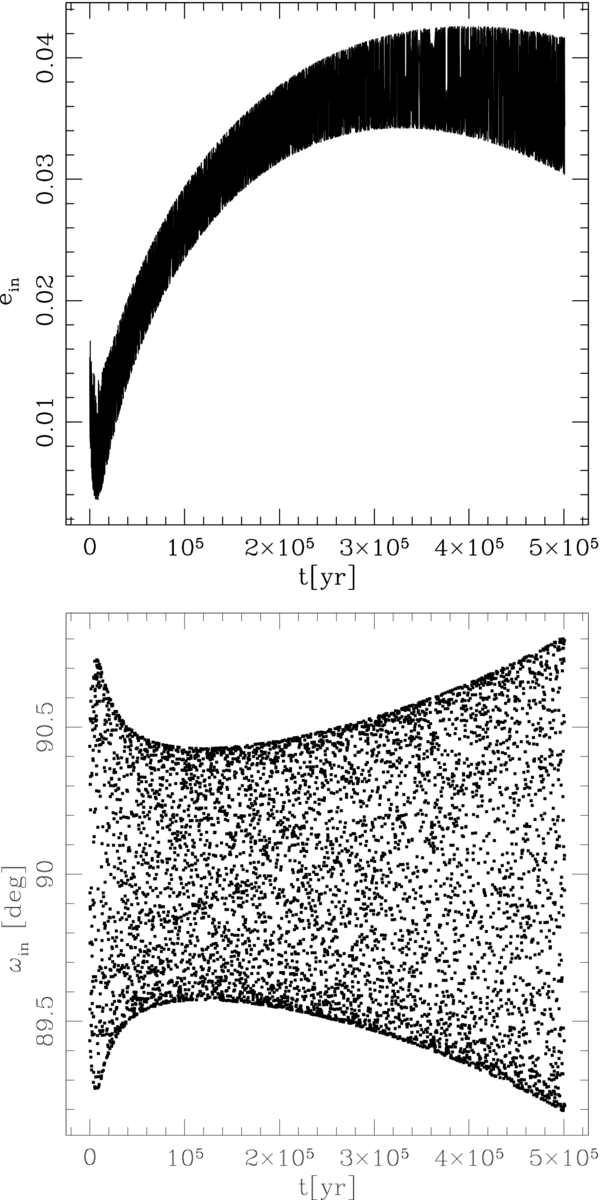
In this subsection we treat gravitational effects of the third body in the octupole approximation. As in the case of the quadrupole approximation, we derive our equations of motion from the double-averaged Hamiltonian (Ford etal. 2000; Blaes etal. 2002; Thompson 2011; Naoz etal. 2011) and we include all of the previously listed dynamical effects. As Figure7 demonstrates, the octupole approximation does not change qualitatively our previous findings. All parameters, except the initial inclination, used in the octupole approximation are listed in Table1. In order to produce the 171day period of the eccentricity oscillations, and the amplitude of the eccentricity oscillation that produces the observed factor of 2–3 variation in luminosity, a slightly higher inclination is required (ı = 451).
5.ON THE VALUE OF Q AND THE ORIGIN OF THE SMALL (OR NEGATIVE) 

The standard theory of Roche lobe overflow predicts  . The measured
  is eight standard deviations away from this value. We have argued in the previous section that
  should be positive, but even if it is two or three standard deviation from the measured value, it is still five below the predicted value. The origin of this discrepancy has been a puzzle since it was discovered.
The suggestion that the binary has a finite eccentricity immediately suggests a reason for the low value of  : tidal dissipation in the white dwarf will tend to reduce the semimajor axis of the orbit, contributing a substantial negative term to
  .
.
The tidal dissipation could in fact dominate the orbital evolution, overcoming the effects of mass transfer as seen in Figure5. We do not argue for this point of view, however, because it would be unlikely that the system could be observed in a stage of the evolution that last only 10−3 of its lifetime. In addition, we believe that the system is trapped in libration.
The observed  consists of at least three parts:

The values of the observed and Roche terms were given above, and, as noted there, they are not consistent with each other. The second term on the right-hand side of Equation(28) represents the acceleration experienced by 1820-30 in the gravitational field of its host globular cluster, while the third term on the right represents the effects of tidal dissipation in the white dwarf secondary.
A natural explanation for the observed negative  might be provided by a combination of the last two effects, but still allow for the system to be trapped in resonance. First, tidal dissipation reduces the intrinsic
  substantially from that expected due to Roche lobe overflow alone, but leaves
  . We then appeal to the argument of van der Klis etal. (1993a) that the
  term produces an apparent negative total
  . Indeed, given the most recent published estimate of amax/c = 7.9 × 10⁻⁸ yr−1 from van der Klis etal. (1993a), it is plausible that we would observe a negative period derivative, while the intrinsic (or physical) period derivative is in fact positive.
However, recent estimates for the cluster acceleration from millisecond pulsar timing suggest a maximum of amax/c = 1.3 × 10⁻⁹ yr−1 (R. Lynch & S. Ransom 2011, private communication), an order of magnitude smaller than the estimate from van der Klis etal. (1993a); if the smaller value holds up, the observed negative period derivative is difficult to understand in the context of current models.
Given that the measured negative period derivative is significant only at the 2σ level, and that there is no clear physical explanation for such an orbital decay, it is worth considering the possibility that the observed value is in error. If we ignore the observed negative period derivative, and simply assume that the intrinsic  is positive, we find a lower limit on Q given by (e/0.009)2Q/k2 > 3.15 × 10⁹. We can get a firmer lower limit on Q by requiring the system to remain trapped in a resonance for a considerable fraction of its lifetime. Given that m2 = 0.067 M☉ and
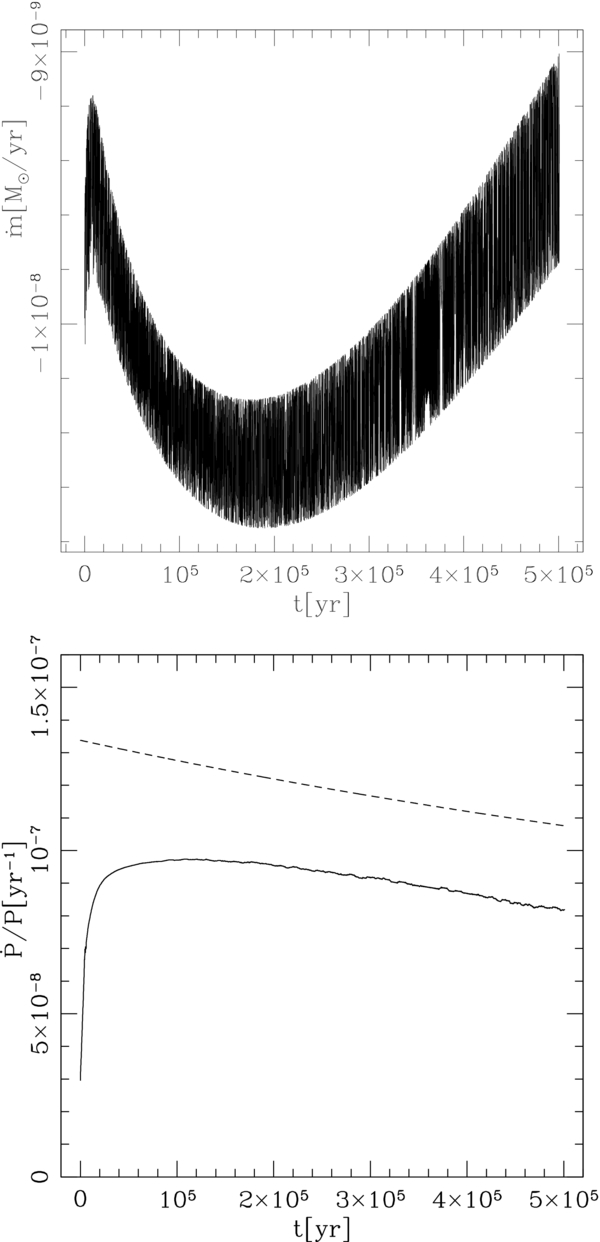
  , the lifetime during which this system can sustain its high X-ray luminosity is estimated to be 7 million years, so a reasonable fraction of its lifetime to remain trapped in a resonance is at least 105 yr. According to our model for (e/0.009)2Q/k2 > 4.0 × 10⁹ the system remains trapped in the resonance for more than 105 yr (see Figure8), and as Figure9 demonstrates, the mass transfer rate remains within roughly 10% of its nominal value
  . In this case, the eccentricity of the inner binary will never damp down to a fixed point because it is indirectly driven up by semimajor-axis expansion due to mass loss on a timescale of order 104 yr, which is at least an order of magnitude shorter than the timescale for eccentricity damping due to tidal dissipation. As expected from the evolutionary scenario the intrinsic period derivative is positive, but because of the effect of tidal dissipation it is smaller than that due to Roche lobe overflow alone (see Figure9); the nominal value for the period derivative due to Roche lobe overflow alone for our system parameters is
  (Rappaport etal. 1987).
Finally, we note that if the inner binary is in fact expanding, the eccentricity will tend to increase as well. If the eccentricity is large enough, then Roche lobe overflow will occur through both the inner and outer Lagrange points, in contradiction with the low observed X-ray absorption. Figure8 shows that the eccentricity, while increasing with time, remains smaller than 0.07, consistent with the lack of mass loss through the outer (L2) Lagrange point (Regös etal. 2005).
5.1.The Nature of the Third Body
If the outer star is a white dwarf or a main-sequence star, its mass is constrained to be ≲ 0.5 M☉ by the lack of an optical detection (Chou & Grindlay 2001). The lack of absorbing material along the line of sight to the X-ray source indicates that the third star is not overflowing its Roche lobe. From the Roche lobe fitting formula of Eggleton (1983),

where q is the mass ratio of the third star to the total mass of the inner binary. This translates to R3 ≲ 0.36 R☉. From Table 9 in Beatty etal. (2007), this implies m3 ≲ 0.39 M☉. We conclude that the only stars with mass ≳ 0.4 M☉ that will fit into the outer orbit is a white dwarf or neutron star (or black hole). This leaves open the possibility that the third star is a main-sequence star with m ≲ 0.4 M☉.
According to Ivanova (2008), her Table 1, the fraction of hierarchical triples consisting of a neutron star primary, a white dwarf secondary, and a white dwarf tertiary formed via binary–binary encounters is about 1.4 × 10⁻³. The fraction of triples consisting of a neutron-star–white-dwarf binary orbited by a 0.4 M☉ (or lower) main-sequence star is similar. The fraction of neutron-star–white-dwarf–neutron-star systems is 2.1 × 10⁻⁵. If this is the primary channel for formation of triple star systems, the third star is likely to be either a white dwarf or a low-mass (m < 0.4 M☉) main-sequence star.
Far-ultraviolet (FUV) observations made with HST reveal an FUV period PFUV ≃ 693 s that is 1% longer than the X-ray period P1 ≃ 685 s (Wang & Chakrabarty 2010). These authors suggest that the FUV period may be consistent with a hierarchical triple system or it may indicate a superhump system, in which the accretion disk is elliptical. If PFUV is a beat period between the orbital period and the orbital period of a third body, the semimajor axis of the third body would be aout ∼ 21 × a. For such a distant third body we do not find a librating solution. Wang & Chakrabarty (2010) suggested the alternative explanation where PFUV is the positive superhump period, and note that to confirm that the system is a superhumper, the detection of the negative superhump is required. The presence of a superhump would explain the longer UV period, but it is not clear how an elliptical disk would produce a 170day variation in the luminosity. It is also worth noting that the system could contain both an elliptical disk and a third star.
6.DISCUSSION
The origin of the 170day luminosity variations in 4U 1820-30 was first attributed to the presence of a third body in the system by Grindlay (1988); this possibility was expanded upon by Chou & Grindlay (2001) and more recently by Zdziarski etal. (2007). Zdziarski etal. (2007) used a numerical model that calculates the time evolution of an isolated hierarchical triple of point masses, using secular perturbation theory up to octupole terms. Their model neglects the effects of tidal and rotational distortion of the white dwarf, tidal friction, mass transfer, and gravitational radiation from the inner binary. Their calculations do include the GR periastron precession of the inner binary.
Zdziarski etal. (2007) find a configuration that reproduces the 171day oscillations (assuming they are due to variations in e). They note that the GR precession rate is near 170days, and then choose a rather low neutron star plus white dwarf mass of 1.29 + 0.07 M☉. With this choice, the period of the GR precession is ∼168days. This period is very near, but slightly shorter than, the observed 171day period. To arrive at the longer period, they choose the location and inclination of the third body so that the Kozai torque results in a retrograde precession. When added to the GR precession, this retrograde Kozai precession ensures the period of eccentricity oscillations will be longer than 168days. They are driven to a much lower magnitude for the Kozai torque than employed in this paper; they use aout = 8.66a and i0 = 4096. They start with ω = 0° and e = 10−4, ensuring that their solution circulates rather than librating.
They note that the apparent near equality between the Kozai and GR precession rates is "a very remarkable coincidence," but go on to say that they do not have any explanation for this coincidence.
We have argued that the origin of the 171day period of the luminosity variation of LMXB 4U 1820-30 arises from libration in the Kozai resonance. This trapping explains why the Kozai precession rate is comparable to the sum of the other precession rates in the problem. If k2 is small enough, then the largest precession frequency in the absence of a third body is that given by GR. In that case, the Kozai and GR precession rates will sum to zero, i.e., the magnitude of the two precession rates will be equal. Hence if k2 is small, then the expansion of the orbit of the inner binary naturally explains the "remarkable coincidence" noted by Zdziarski etal. (2007). We stress that, independent of the value of k2, the natural state of the system is likely to be libration rather than circulation.
Trapping into libration is a consequence of mass-transfer-driven orbital expansion in the inner binary. We have pointed out that the apparent negative period derivative, if it were intrinsic to the system, would not last for reasonable fraction of the system's lifetime. We find this to be an untenable situation.
The observed negative period derivative of the inner binary allows us to constrain the tidal dissipation factor Q yielding a very firm lower limit of (e/0.009)2Q/k2 > 3.15 × 10⁹. We argue, however, that (e/0.009)2Q/k2 has to be still higher, to trap and maintain the system in libration around the stable Kozai fixed point. Our finding indicates that if 4U 1820-30 is indeed a triple system, the negative period derivative is not an intrinsic property of the system. However, as we showed in Section5 it does not arise from the acceleration of the gravitation field of the globular cluster in which 4U 1820-30 resides, as suggested by van der Klis etal. (1993a).
In general, the eccentric orbit of a close binary system similar to 4U 1820-30 could lead to a time-dependent irradiation of the secondary which could, in turn, give rise to a thermal tide (Arras & Socrates 2010). A thermal tidal torque opposes the gravitational tidal torque, tending to force the secondary away from synchronous rotation and to enhance the orbital eccentricity. An asynchronous spin may cause large tidal heating rates, depositing heat in the interior of the secondary. In addition, the irradiation of the stellar surface by the neutron star (or by the accretion disk) will reduce the heat flux from the center of the white dwarf outward, so these irradiated white dwarfs will be hotter than passively cooling white dwarfs. Since they are hotter, they will have larger radii. The interplay between the two tidal torques would eventually set the equilibrium spin state. As long as this equilibrium state is not reached, the resulting bulge may oscillate, causing a periodic exchange of angular momentum between the orbit and the spin of the white dwarf. This might provide an alternate mechanism for producing the luminosity variations in 4U 1820-30. Since this period is very stable,  according to Chou & Grindlay (2001), we are currently looking into possibility of such an interplay between gravitational and thermal tidal torque as an explanation for 171day period in 4U 1820-30.
We anticipate that the resonance trapping mechanism we have described in this paper is generic in Roche lobe overflow binaries in triple systems. The exact nature of the librating orbit will vary with the properties of the particular system. For example, for a binary with a larger semimajor axis, such that  , resonant trapping will lead to
  .
.
7.CONCLUSIONS
This paper provides an estimate for a lower limit of the tidal dissipation parameter Q for a helium white dwarf. It also elucidates the possible evolutionary history of 4U 1820-30, i.e., how the system arrived at a state where the secular dynamics are not dominated by the effects of the white dwarf's tidal bulge, despite the fact that the white dwarf is overflowing its Roche lobe in an orbit with a period of 685 s.
We suggest that the system is trapped in Kozai resonance. This resonance trapping is responsible for the observed 171day period, which we interpret as the period of small oscillations around a stable fixed point in the Kozai resonance. If the system is not librating, one requires very fine tuning to get the 171day period.
We provide lower limit on the tidal dissipation rate, as measured by the factor Q; (e/0.009)2Q/k2 > 4 × 10⁹.
Further exploration of the long-term (tidal and mass-overflow-driven) evolution of this and similar short-period ultracompact X-ray binaries is clearly warranted. Inclusion of the thermal tides into dynamics of these systems may introduce an alternative explanation for origin of long-period modulation of the light curve. For the particular case of 4U 1820-30, better modeling of the gravitational potential in the host globular cluster, NGC 6624, would allow for an upper limit on Q. We are pursuing both lines of investigation.
The authors are grateful to Natasha Ivanova, Cole Miller, Doug Hamilton, Andrew Cumming, and Phil Arras for helpful discussions. This research has made use of the SIMBAD database, operated at CDS, Strasbourg, France, and of NASA's Astrophysics Data System. The authors are supported in part by the Canada Research Chair program and by NSERC of Canada.
APPENDIX A: EQUATIONS OF MOTION
The equations of motion we employ model the Kozai interaction, the dynamical effects of the tidal bulge of the He white dwarf, GR periastron precession, the rotational bulge of the He white dwarf, conservative mass transfer driven by the emission of gravitational radiation, and tidal dissipation. We do not consider tides raised on the neutron star primary. Detailed derivation of the equations representing Kozai cycles with tidal friction and GR periastron precession can be found in Eggleton etal. (1998) and Eggleton & Kiseleva-Eggleton (2001). Stellar masses are denoted by m1 (the mass of the neutron star primary), m2 (the mass of the white dwarf secondary), M ≡ m1 + m2 (the inner binary mass), m3 (the mass of the outer companion), and the reduced mass of the inner binary μ = m1m2/(m1 + m2). The mean motion of the inner binary is n = 2π/P = [GM/a3]1/2. The inner binary orbital elements are semimajor axis a, eccentricity e, mutual inclination between the inner binary and the outer binary orbit ı, the argument of periastron ω, and the longitude of ascending node Ω. k2 is the tidal Love number, Q is the tidal dissipation factor, and R2 is the radius of the white dwarf. The orbital parameters of the outer binary are denoted aout and eout. G is Newton's constant and c is the speed of light.
Changes in the semimajor axis of the inner binary a are caused by tidal dissipation and mass transfer:

where
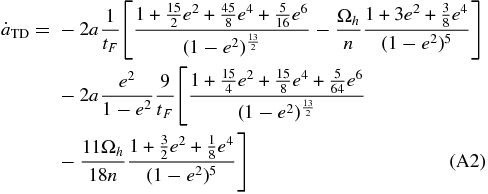

with  given by

For the zero eccentricity case, Equation(A4) is derived in detail in Rappaport etal. (1987), where instead of the dependency on periastron period Pperiastron they consider dependency on binary period.
The tidal friction timescale is

The eccentricity of the inner binary e is affected by the Kozai torque and by tidal dissipation:

where


The mutual inclination between the inner and the outer binary orbit, ı, is affected by Kozai torques, the rotational bulge, and by tidal dissipation:

where



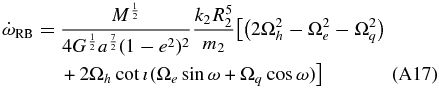
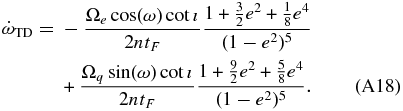
Besides the negative precession rate of the argument of periastron due to Kozai cycles, the total precession rate of the argument of periastron has additional positive contributions from the tidal bulge, GR, the rotational bulge, and the tidal dissipation:

where



The precession of the longitude of ascending node is caused by Kozai cycles, rotational bulge, and tidal dissipation:

where



APPENDIX B: ADIABATIC INVARIANCE OF THE ACTION
Time-dependent Hamiltonians, even those with just one degree of freedom, can be difficult to solve. However, for Hamiltonians where the time dependence is sufficiently slow, the problem is easier to tackle due to the existence of variables that are almost constant. The approximate constants are the action variables of the Hamiltonian, when the slow time dependence is neglected. Suppose that the time dependence enters through a time-dependent parameter κ(t). If the parameter κ varies very slowly with time, treating κ as time-independent parameter allows us to find action-angle variables following the standard prescription. These action-angle variables are function of time through κ(t), which leads to the action no longer being a constant of motion. However, when κ varies slowly with time, the action is nearly constant. Such an action is known as an adiabatic invariant.
As described in Section3, capture in the resonance is a natural consequence of semimajor-axis expansion driven by mass transfer from the white dwarf. The Hamiltonian of our system (see Equation(4)) is a function of the semimajor axis, which is a parameter of H, playing the role of κ(t). In our case the semimajor axis is not the only parameter varying with time; the masses of the inner binary vary with time as well. Here we show, both analytically and via numerical integration, that the change in the eccentricity is coupled to the change in the semimajor axis. When the semimajor axis expands (respectively, contracts) the eccentricity of the stable fixed point increases (decreases). We also demonstrate that the timescale for the change in the eccentricity is a factor of ≳ 150 shorter than the timescale for the semimajor axis.
To find the action, we expand our Hamiltonian (Equation(4)) around the fixed point:


Since we are expanding around the resonance, all terms  vanish. After some algebra we find
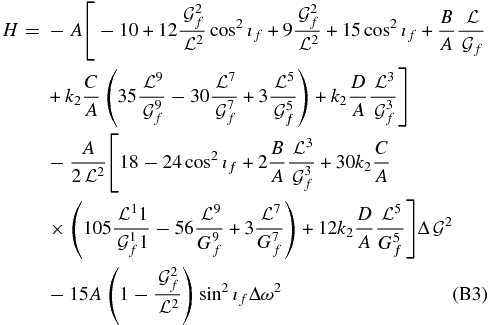
which is similar to the Hamiltonian of the harmonic oscillator. Written more compactly (and implicitly defining α(t), β(t), and  ),
),

We solve for  and evaluate the integral

where  . We find

Plugging in the corresponding terms from Equation(B3) yields

where
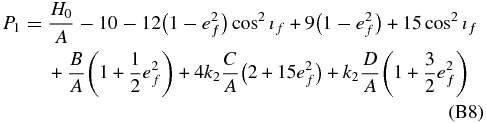
and
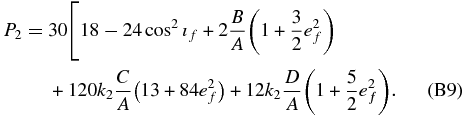
Since the action J is an adiabatic invariant, we have

The partial derivatives are




Plugging these partial derivatives back into Equation(B10) yields

The inner binary orbit is eccentric, which makes the mass transfer rate proportional to periastron distance rp = a(1 − e). Hence, the  term can be decoupled into two terms, one proportional to
  and the other proportional to
  :
:

Combining Equations(B15) and(B16) and solving for  leads to
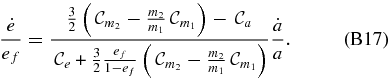
Plugging in the numerical values,

Defining the timescales for the eccentricity and the semimajor axis to decay or increase (depending on the value of Q) as  and
and  , the timescales in Equation(B18) are related by

To demonstrate that the eccentricity evolution is indeed a consequence of the action being an adiabatic invariant, we follow the evolution of the orbit around the fixed point ef = 0.0155 and ωf = 90°. Figure10 shows  as a function of time in a case where the semimajor axis is increasing, meaning that tidal dissipation is sufficiently weak so that the evolution of the semimajor axis is dominated by mass transfer (Q = 8 × 10⁷). The solid line presents
  predicted by Equation(B18). For t ≳ 105 yr, the numerical integration gives
  corresponding to a timescale 150 times shorter than the timescale for the semimajor axis.
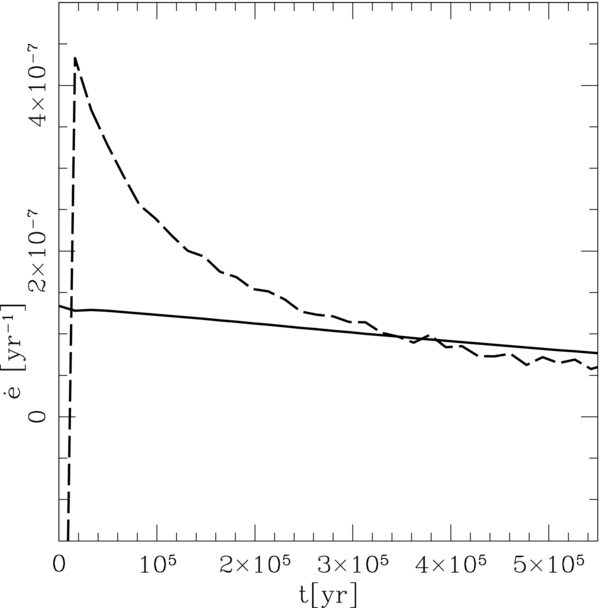
Despite the fact that the semimajor axis is expanding, the numerical integration shows a transient phase (roughly the first 2000 years) where de/dt < 0, and a longer phase (∼105 yr) where  is larger than predicted by Equation(B18). There are contributions to the eccentricity evolution which we have ignored in our analytic treatment; for example, the spin of the white dwarf is not locked during the evolution of the system. These unmodeled contributions are the source of the transient behavior.
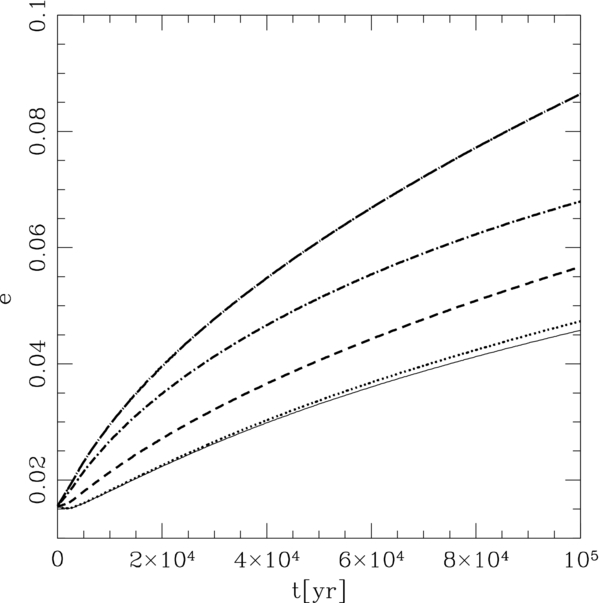
To support this statement, we illustrate the eccentricity evolution in various cases where we turn off different dynamical effects in Figure11. The solid line presents a result from the numerical integration that includes all dynamical effects in our model, while the dotted line is the same integration with the  term set to 0; the result shows that direct tidal dissipation on the eccentricity (Equation(A8)) is not dynamically significant. The dashed line presents the case where
  is set to 0 (see Equation(A2)); the result shows that
  has a significant influence on the eccentricity evolution. The dash-dotted line shows the eccentricity when the tidal dissipation factor Q is set to infinity, but only in the differential equations that govern spin evolution. The long-dash-dotted line shows the eccentricity evolution in the case where Q is set to infinity in the equations that govern the evolution of the spins together with
  being set to 0. The latter three cases demonstrate that the eccentricity starts increasing immediately with the semimajor-axis expansion, which is exactly the behavior predicted by the analytic analysis. After 5.5 × 10⁵ yr the eccentricity becomes ≳ 0.1 and since our analytic estimate is valid only for small eccentricities we stop the integration here.
The cause of the transient behavior is that the spin of the white dwarf is not, contrary to our choice of initial conditions, tidally locked during the evolution of the system. Whether the spin settles down in some Cassini state or other stable configuration later during the evolution of the system is a possibility open to further investigation.
